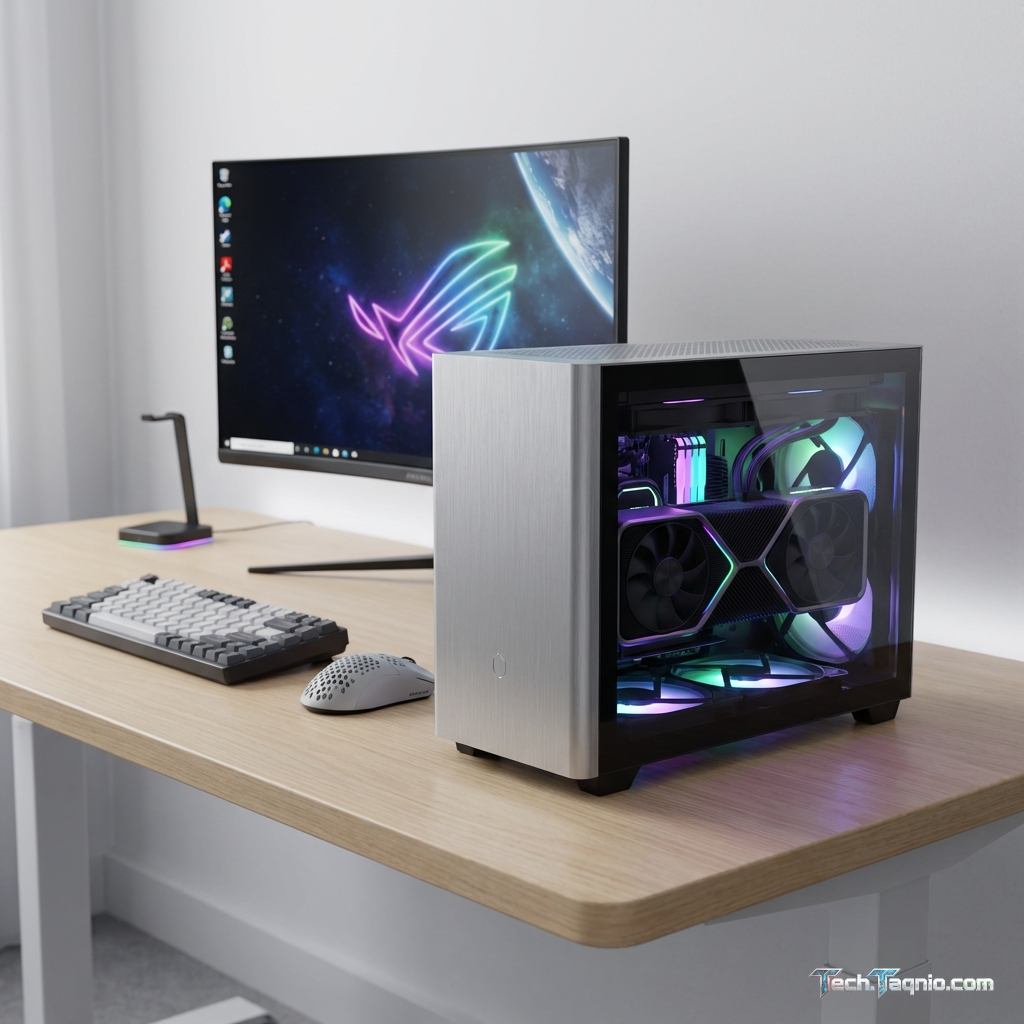
Space constraints shouldn’t prevent exceptional gaming experiences. Modern mini gaming PCs deliver performance
rivaling full-tower systems while occupying a fraction of the desk real estate. Whether you’re gaming in a small
apartment, college dorm, or simply prefer minimal setups, compact form factor PCs provide powerful solutions without
sacrificing capability.
The mini PC market has evolved dramatically, with manufacturers offering systems that pack desktop-class GPUs into
cases smaller than shoe boxes. These compact powerhouses handle demanding games, support high-refresh-rate monitors,
and maintain manageable thermals despite condensed dimensions. Understanding the trade-offs and available options
helps identify the right compact gaming solution for your space and requirements.
This comprehensive guide examines the best mini gaming PCs for small spaces in 2026, covering pre-built options,
component considerations, and practical factors for compact gaming setups.
I. Understanding Mini Gaming PC Form Factors
Compact gaming systems span several form factors with different trade-offs between size, performance, and
expandability.
Small Form Factor (SFF) Classifications
Mini-ITX Systems (10-20 liters): The smallest systems capable of housing desktop GPUs. These cases
measure roughly shoebox-sized and support full-length graphics cards in optimized designs. Performance approaches
standard desktop levels with proper cooling.
Micro-ATX Compact (20-30 liters): Slightly larger cases offering more expansion options while
remaining significantly smaller than mid-towers. These systems provide better cooling potential and easier builds
than Mini-ITX alternatives.
Console-Sized Systems (5-10 liters): Ultra-compact designs roughly PlayStation/Xbox-sized, typically
using mobile or low-profile GPUs. Gaming capability exists but with notable compromises compared to larger systems.
Mini PCs (under 5 liters): The smallest category, often relying on integrated graphics or external
GPU enclosures. Gaming capability varies dramatically based on processor graphics capabilities.
Performance Expectations by Size
Size correlates directly with thermal capacity and therefore performance sustainability:
- 15-20 liters: Full desktop performance with RTX 4070/4080-class GPUs possible
- 10-15 liters: High performance with RTX 4060/4070-class GPUs, some thermal considerations
- 5-10 liters: Good performance with RTX 4060 or lower-TDP cards
- Under 5 liters: Limited to integrated graphics or external GPU solutions
Each size reduction requires either accepting lower GPU tiers or paying significantly more for advanced cooling
solutions that maintain performance in constrained spaces.
Cooling Challenges in Compact Systems
Small cases present unique thermal management challenges that affect component selection and system design:
Airflow restrictions: Limited case volume reduces available airflow paths, requiring careful fan
placement and higher-RPM operation for adequate cooling.
Component proximity: CPUs and GPUs sit closer together, creating heat concentration zones that
require targeted cooling strategies.
Cable management impact: Cables in small cases obstruct airflow more significantly than in larger
systems, making management critical rather than cosmetic.
Noise considerations: Smaller fans spinning faster create more noise than larger fans moving
equivalent airflow. Acoustic performance often suffers in compact systems under load.
II. Best Pre-Built Mini Gaming PCs
Pre-built compact gaming systems offer optimized designs with components selected for small-space compatibility.
ASUS ROG NUC (2026) – Best Ultra-Compact
The ASUS ROG NUC represents premium ultra-compact gaming, packing desktop-class performance into remarkably small
dimensions.
Key Specifications:
- Volume: 2.5 liters
- Processor: Intel Core Ultra 9 185H (16 cores)
- Graphics: NVIDIA GeForce RTX 4070 Laptop (8GB)
- RAM: 32GB DDR5-5600
- Storage: 1TB PCIe 4.0 NVMe SSD
- Dimensions: 270 × 180 × 50mm
- Price Range: $1,999-$2,299
Despite measuring barely larger than a thick book, the ROG NUC delivers 1440p gaming capability through its mobile
RTX 4070. Performance approaches 80-90% of desktop equivalents in well-cooled conditions, though thermal throttling
may occur during extended demanding sessions.
Pros: Remarkably compact, strong performance for size, premium build quality, comprehensive
connectivity.
Cons: Premium pricing, mobile GPU rather than desktop, limited upgradeability, thermal constraints
under sustained load.
Intel NUC 14 Extreme – Best Balance
The Intel NUC 14 Extreme (“Beast Canyon” successor) offers desktop GPU support in a compact but capable chassis.
Key Specifications:
- Volume: 8 liters
- Processor: Intel Core i9-14900K (24 cores)
- Graphics: Supports full-length desktop GPUs up to 12 inches (RTX 4070 Ti recommended)
- RAM: Up to 64GB DDR5
- Storage: Two M.2 NVMe slots
- Dimensions: 317 × 243 × 120mm
- Price Range: $1,299-$1,599 (barebones), $2,499+ configured
The NUC Extreme fits genuine desktop performance in console-adjacent dimensions. Full desktop GPUs provide gaming
experiences indistinguishable from tower systems, though noise increases under load due to compact cooling
constraints.
Pros: Desktop GPU support, excellent CPU performance, relatively compact, upgradeable components.
Cons: Noise under load, barebones configuration requires additional purchases, still larger than
ultra-compact options.
ZOTAC MAGNUS One – Best Value Compact
ZOTAC’s MAGNUS One series delivers pre-configured compact gaming at more accessible pricing than premium
alternatives.
Key Specifications:
- Volume: 8.3 liters
- Processor: Intel Core i7-14700 (20 cores)
- Graphics: NVIDIA GeForce RTX 4060 Ti (8GB)
- RAM: 16GB DDR5
- Storage: 1TB NVMe SSD
- Dimensions: 225 × 203 × 128mm
- Price Range: $1,399-$1,599
The MAGNUS One provides solid 1080p/1440p gaming in a cube-shaped design that fits virtually anywhere. The RTX 4060
Ti handles most games at high settings while maintaining reasonable thermals in the compact enclosure.
Pros: Competitive pricing, good performance, attractive design, plug-and-play ready.
Cons: Limited GPU upgrade path, 16GB RAM may require expansion, proprietary components limit
modifications.
Corsair ONE i500 – Best Premium
The Corsair ONE i500 represents ultimate compact gaming luxury with advanced cooling in a striking cylindrical
design.
Key Specifications:
- Volume: 12 liters
- Processor: Intel Core i9-14900K
- Graphics: NVIDIA GeForce RTX 4080 Super
- RAM: 64GB DDR5
- Storage: 2TB NVMe SSD
- Dimensions: 200 × 200 × 380mm
- Price Range: $3,999-$4,499
The ONE i500 achieves desktop-class performance through custom liquid cooling that handles high-end components
despite compact dimensions. The unique convection-assisted chimney design exhausts heat efficiently, enabling
sustained performance that rivals full-tower systems.
Pros: Exceptional performance, quiet operation, premium build quality, striking design.
Cons: Very expensive, limited upgradability, tall profile may not fit all spaces.
III. Building Your Own Mini Gaming PC
Custom mini-ITX builds offer maximum control over components and potential cost savings compared to pre-built
alternatives.
Recommended Mini-ITX Cases
NZXT H1 V2: 14.4-liter case with integrated AIO cooler and SFX power supply. Supports full-length
dual-slot GPUs. Excellent thermal performance for the size class.
Cooler Master NR200P MAX: 18.3-liter case including AIO and SFX power supply. Accommodates larger
GPU and CPU cooling solutions than smaller alternatives. Good balance of size and capability.
Dan Case A4-H2O: 11.5-liter sandwich-style case designed for AIO cooling. Supports 3-slot GPUs up to
306mm. Premium option for enthusiasts prioritizing minimum footprint.
SSUPD Meshlicious: 16-liter mesh-front case with excellent airflow. Flexible GPU support including
4-slot cards in appropriate configurations. Popular among custom builders.
Component Selection for Small Builds
Motherboard: Mini-ITX motherboards (170×170mm) fit all compact cases. Quality examples include ASUS
ROG Strix, MSI MEG, and Gigabyte AORUS lines for both Intel and AMD platforms.
Power Supply: SFX or SFX-L form factor required for most compact cases. Corsair SF750, Silverstone
SX-series, and Cooler Master V SFX Gold provide reliable compact power options.
CPU Cooler: Height restrictions vary by case. Many require AIO liquid cooling or low-profile air
coolers. Noctua NH-L9 and L12S fit most restricted spaces.
Graphics Card: Length and width matter significantly. Verify case GPU clearances before purchasing.
Many cases require 2-slot or 2.5-slot designs rather than 3-slot behemoths.
RAM: Standard DDR5 DIMMs fit Mini-ITX boards. Two slots limit capacity to 64GB maximum (2×32GB),
sufficient for gaming.
Building Tips for Compact Systems
- Plan cable routing before installing components—small cases require specific routing paths
- Use short custom cables rather than managing excess lengths from standard cables
- Install motherboard components (CPU, RAM, M.2) before case installation
- Apply appropriate thermal paste quantities—neither too much nor too little
- Configure fan curves for balanced noise/thermal performance
- Monitor temperatures during initial testing to verify adequate cooling
IV. Comparison and Recommendations
Choosing between options depends on space constraints, performance requirements, and budget:
V. Conclusion
Mini gaming PCs prove that powerful gaming doesn’t require massive tower cases. Modern compact systems deliver
desktop-class experiences in dramatically reduced footprints, enabling gaming in spaces previously considered
impractical.
For absolute minimum dimensions, the ASUS ROG NUC provides remarkable performance in book-sized packaging. The Intel
NUC Extreme offers the best balance of size and desktop GPU capability. Budget-conscious buyers find excellent value
in the ZOTAC MAGNUS One, while the Corsair ONE i500 represents premium compact gaming at its finest.
Custom Mini-ITX builds reward those willing to research and build, offering personalized configurations at
potentially lower costs than pre-built equivalents. Whichever path you choose, small-space gaming has never been
more accessible or capable.
For related content, explore our pre-built gaming PC
guide and PC case
recommendations.