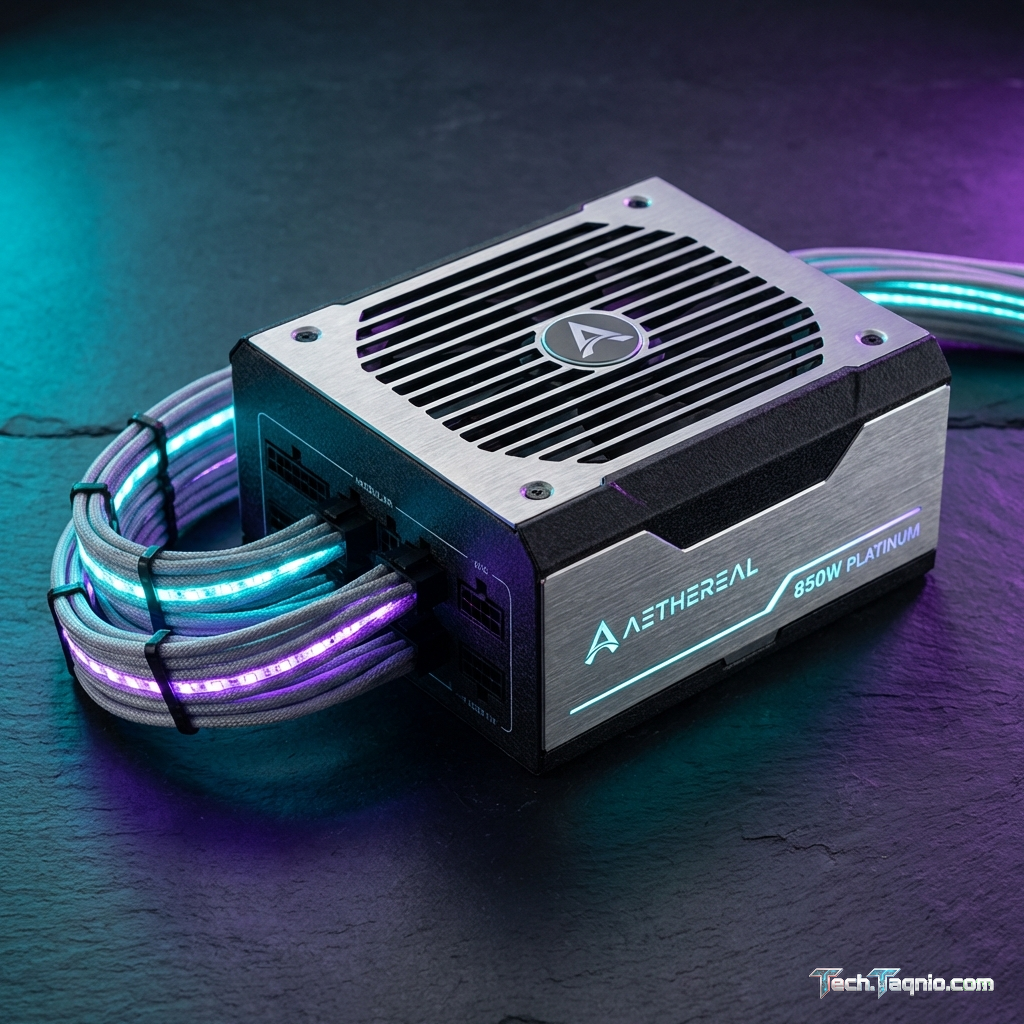
The power supply unit forms the foundation of system stability and component safety, yet PSU selection often receives
less attention than more glamorous components. Modern GPUs with increasing power demands and transient load spikes
make appropriate PSU selection more important than ever. Underpowered or low-quality units risk crashes,
instability, and potentially component damage.
Beyond raw wattage, efficiency ratings, build quality, and connector availability significantly impact PSU
suitability for gaming builds. Understanding these factors helps match power supply capabilities to actual system
requirements while avoiding both underspending on critical quality and overspending on unnecessary capacity.
This comprehensive guide examines gaming PSU selection in 2026, covering wattage calculation, efficiency ratings,
quality considerations, and specific recommendations for different build tiers.
I. Understanding PSU Specifications
PSU specifications determine capability and quality. Understanding these ratings enables informed comparison.
Wattage Rating
Continuous wattage indicates sustained power delivery capability. Quality PSUs maintain rated wattage under full
load; budget units may fail to deliver advertised power reliably.
Peak wattage indicates brief burst capability—useful for handling transient spikes but not sustained loads. Don’t
size builds based on peak ratings.
80 Plus Efficiency Ratings
80 Plus certification indicates power conversion efficiency—higher efficiency means less wasted electricity and less
heat generation.
| Rating | 50% Load Efficiency | Typical Price Premium | Recommendation |
|---|---|---|---|
| 80 Plus | 80% | Baseline | Avoid for gaming |
| 80 Plus Bronze | 85% | Low | Budget builds |
| 80 Plus Gold | 90% | Moderate | Recommended standard |
| 80 Plus Platinum | 92% | High | High-end builds |
| 80 Plus Titanium | 94% | Very High | Enthusiast only |
Modularity
Non-Modular: All cables permanently attached. Lower cost but excess cables require management and
storage.
Semi-Modular: Essential cables (24-pin, CPU) attached; others detachable. Good balance of cost and
flexibility.
Fully Modular: All cables detachable. Maximum flexibility and cleaner builds. Premium pricing.
Form Factor
ATX: Standard full-size PSU (150mm x 86mm x various depths). Compatible with most cases.
SFX/SFX-L: Compact form factor for small form factor builds. Limited high-wattage options but
improving.
II. Wattage Calculation
Properly sizing PSU wattage prevents instability while avoiding unnecessary overspending.
Component Power Consumption
CPUs (approximate):
• Ryzen 5 7600: 65-88W
• Core i5-14600K: 125-181W peak
• Ryzen 7 7800X3D: 120W
• Core i9-14900K: 125-253W peak
GPUs (approximate TDP/total board power):
• RTX 4060: 115W
• RX 7600: 165W
• RTX 4070: 200W
• RX 7800 XT: 263W
• RTX 4080 Super: 320W
• RTX 4090: 450W
Other components:
• RAM: 5-10W per DIMM
• SSD: 5-10W
• HDD: 10-15W
• Fans: 2-5W each
• Motherboard: 30-80W
Transient Power Spikes
Modern GPUs, particularly NVIDIA RTX 40-series, generate brief power spikes significantly exceeding TDP. The RTX 4090
can spike to 600W+ briefly. PSUs must handle these transients without triggering protection circuits.
AMD GPUs generally have smaller transient spikes. Build PSU headroom around anticipated GPU transients, not just TDP.
Recommended Wattage by Build Tier
| Build Tier | Typical GPU | Minimum PSU | Recommended |
|---|---|---|---|
| Budget ($800-1000) | RTX 4060/RX 7600 | 500W | 550-650W |
| Mid-Range ($1200-1500) | RTX 4070/RX 7800 XT | 600W | 650-750W |
| High-End ($2000+) | RTX 4080/RX 7900 XT | 750W | 850W |
| Enthusiast ($3000+) | RTX 4090 | 850W | 1000-1200W |
III. PSU Quality Indicators
Beyond specifications, quality factors determine reliability and safety.
Brand Reputation
Tier A (Highly Recommended): Corsair, Seasonic, EVGA, be quiet!, Super Flower
Tier B (Good): NZXT, Cooler Master, Phanteks, XPG, MSI
Tier C (Caution): Budget brands—research specific models carefully
Warranty Length
Quality PSUs offer 7-10 year warranties. Budget units typically offer 3-5 years. Warranty length generally correlates
with manufacturer confidence in component quality.
OEM Platform
Many brands use OEM designs from manufacturers like Seasonic, CWT, and Great Wall. Research which platform underlies
specific models—two different brands may share identical internals.
Protection Features
Quality PSUs include:
• OVP (Over Voltage Protection)
• UVP (Under Voltage Protection)
• SCP (Short Circuit Protection)
• OCP (Over Current Protection)
• OTP (Over Temperature Protection)
IV. ATX 3.0 and 12VHPWR
New standards address modern GPU requirements.
ATX 3.0 Specification
ATX 3.0 defines improved transient response capability, supporting brief power spikes up to 200% of rated capacity on
the 12V rail. This addresses RTX 40-series transient requirements more reliably.
12VHPWR Connector
The 12V High Power connector (12VHPWR/12V-2×6) provides up to 600W through a single cable, replacing multiple 8-pin
PCIe connections for high-power GPUs.
Native 12VHPWR: ATX 3.0 PSUs include native 12VHPWR cables—recommended for RTX 40-series builds.
Adapter Cables: Older PSUs can use adapter cables. Ensure cables are seated completely and avoid
excessive bending near the connector.
V. Best Gaming PSU Recommendations
Budget Tier: 550-650W
Corsair CX650M (650W Bronze) – $70-85
Semi-modular with reliable performance. Adequate for mid-range builds. Good value for budget systems.
be quiet! Pure Power 11 FM (650W Gold) – $85-95
Excellent quiet operation with 80 Plus Gold efficiency. Great budget-to-mid option.
Mid-Range Tier: 750W
Corsair RM750 (750W Gold) – $100-115
The mainstream standard. Fully modular, quiet operation, excellent reliability. Works with RTX 4070 Ti and below
comfortably.
EVGA SuperNOVA 750 G7 (750W Gold) – $95-110
Compact design with excellent performance. Strong alternative to Corsair.
High-End Tier: 850-1000W
Corsair RM850x (850W Gold) – $130-150
Premium build quality for high-end systems. Handles RTX 4080 with headroom.
MSI MEG Ai1000P PCIE5 (1000W Platinum) – $200-230
ATX 3.0 with native 12VHPWR. Excellent for RTX 4090 builds. Premium quality and efficiency.
Enthusiast Tier: 1200W+
Corsair HX1200 (1200W Platinum) – $250-280
Flagship efficiency and reliability. Handles any gaming configuration with substantial headroom.
Seasonic PRIME TX-1300 (1300W Titanium) – $350-400
Maximum efficiency and quality. For builds where only the best suffices.
VI. Common PSU Mistakes
Buying by Wattage Alone
A cheap 750W PSU may underperform quality 650W units. Prioritize quality over raw wattage within reasonable sizing.
Ignoring Transient Requirements
RTX 40-series can trigger shutdowns on technically “adequate” PSUs due to transient spikes. Size for transients, not
just TDP.
Reusing Old PSUs
PSU capacitors degrade over time. Units over 7-10 years old may no longer deliver rated performance reliably. Factor
PSU replacement into major upgrades.
Extreme Over-Provisioning
1000W PSUs for 300W systems waste money and operate inefficiently (PSUs operate best at 50-80% load). Size
appropriately, not excessively.
VII. Conclusion
PSU selection directly impacts system stability, safety, and longevity. Prioritize quality from reputable
manufacturers over raw wattage or low pricing. Calculate actual power requirements including transient spikes, then
add reasonable headroom.
For most gaming builds, 80 Plus Gold efficiency provides optimal balance of cost and efficiency. Fully modular
solutions simplify building and cable management. ATX 3.0 adoption is recommended for RTX 40-series builds.
The PSU protects significant component investments—don’t economize excessively on this foundation. A quality 650-850W
PSU from established manufacturers serves most gaming builds reliably for years.
For complete build guidance, explore our articles on best gaming GPUs 2026 and
building a gaming
PC.