Gaming laptops typically prioritize raw performance over portability, resulting in heavy machines with large
footprints that challenge mobile users. Yet many gamers need genuine portability without sacrificing meaningful
gaming capability—frequent travelers, students with limited desk space, or professionals who game after work in
various locations. The sub-15-inch gaming laptop category addresses these needs, delivering surprising power in
compact, lightweight packages.
Smaller gaming laptops involve genuine engineering challenges. Heat dissipation becomes more difficult in compact
chassis, requiring creative cooling solutions or performance compromises. Battery capacity shrinks with chassis
size, limiting unplugged usage. Display size affects gaming visibility, particularly for detail-intensive titles.
Manufacturers addressing these challenges successfully create genuinely impressive machines for mobile gamers.
This comprehensive guide examines the best portable gaming laptops under 15 inches available in 2026, analyzing
performance, build quality, battery life, and value across leading models. Whether you’re seeking maximum gaming
capability in minimum footprint or balanced portability with solid gaming, you’ll find appropriate options.
I. Understanding Compact Gaming Laptop Trade-offs
Before examining specific models, understanding the inherent trade-offs in smaller gaming laptops helps set
appropriate expectations and identify which compromises matter for your specific use case.
Thermal Constraints and Performance
Cooling system effectiveness directly determines sustained performance in gaming laptops. Larger chassis accommodate
bigger fans, more extensive vapor chambers, and additional heat pipes that maintain lower temperatures under load.
Compact laptops work with less cooling surface area and smaller components, often resulting in higher temperatures
or reduced sustained performance.
Manufacturers address thermal constraints through several approaches. Some throttle maximum performance, running
hardware at lower power levels that produce less heat. Others accept higher operating temperatures, potentially
affecting component longevity. Premium designs implement innovative cooling solutions—liquid metal thermal
compounds, enhanced vapor chamber designs, and aggressive fan curves that maintain performance at the cost of
increased noise.
Gaming performance specifications often reflect burst capability rather than sustained performance. A 14-inch laptop
listing RTX 4070-equivalent specifications may deliver that performance briefly before thermal throttling reduces
frame rates. Understanding real-world sustained performance proves more valuable than specification sheet
comparisons.
Display Size Considerations
Screen size affects gaming experience differently across game genres. Competitive esports titles with minimal UI
elements remain fully playable on 13-14 inch displays. Complex strategy games, RPGs with extensive interfaces, or
simulation titles may feel cramped on smaller screens, with important information becoming difficult to read.
Resolution interacts with display size for perceived sharpness. A 14-inch 1080p display provides excellent pixel
density (approximately 157 PPI), appearing sharper than a 17-inch 1080p display (127 PPI). Higher resolutions like
2560×1600 on 14-inch panels deliver exceptional clarity, potentially eliminating anti-aliasing requirements and
reducing GPU load.
Viewing distance affects comfortable usage. Laptop displays typically sit closer to users than external monitors,
partially compensating for smaller physical size. Many portable gaming laptop users game in coffee shops, airplanes,
or hotel rooms where limited space places displays at shorter distances anyway.
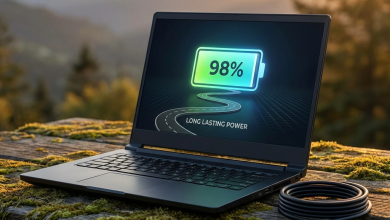
Battery and Portability Reality
Smaller chassis limit battery capacity, though not always as dramatically as expected. The ASUS ROG Zephyrus G14 fits
76Wh in its compact frame, while some 17-inch gaming laptops only include 60-80Wh batteries. Compact gaming laptops
often achieve better battery life than larger alternatives due to smaller, more efficient displays and components
optimized for portable use.
True portability encompasses weight, dimensions, and power adapter considerations. A 1.5kg laptop remains portable
only if its 300W power brick doesn’t add another kilogram to travel weight. Compact gaming laptops typically pair
with smaller adapters (100-180W typical), reducing total travel weight advantage over specifications alone.
II. Best Portable Gaming Laptops Under 15 Inches
The following models represent the best compact gaming options available in 2026, balancing performance, portability,
build quality, and value.
ASUS ROG Zephyrus G14 (2026) – Best Overall
The ASUS ROG Zephyrus G14 defines the compact gaming laptop category, delivering exceptional performance in a 14-inch
chassis that weighs just 1.5 kg. The 2026 refresh addresses previous generation limitations while maintaining the
portable excellence that established the line.
Key Specifications:
- Processor: AMD Ryzen 9 8945HS (8 cores, 16 threads, up to 5.2GHz)
- Graphics: NVIDIA GeForce RTX 4070 Laptop (8GB GDDR6)
- Display: 14″ OLED, 2880×1800, 120Hz, 100% DCI-P3, 0.2ms response
- RAM: 32GB LPDDR5X-7500 (soldered)
- Storage: 1TB PCIe 4.0 NVMe SSD
- Battery: 76Wh (up to 12 hours video playback)
- Weight: 1.5 kg (3.31 lbs)
- Dimensions: 312 × 227 × 16.3 mm
- Price Range: $1,799-$2,099
The OLED display represents a significant upgrade from previous LCD panels, delivering true blacks, exceptional
contrast, and accurate colors straight from the factory. The 2880×1800 resolution provides approximately 242 PPI,
appearing razor-sharp at normal viewing distances. While the 120Hz refresh rate falls below some gaming laptop
displays, OLED response times and smooth motion largely compensate for the reduced refresh ceiling.
AMD’s Ryzen 9 8945HS processor delivers exceptional performance per watt, enabling the Zephyrus G14 to maintain
competitive gaming performance while achieving remarkable battery life. In productivity workloads, the laptop
operates quietly and efficiently, reserving performance for demanding tasks. Gaming activates the full cooling
system, which manages heat effectively despite the compact chassis, though noise levels increase noticeably under
sustained load.
Gaming performance reaches 100+ FPS in competitive titles at native resolution with high settings. Demanding AAA
games typically maintain 60-80 FPS with adjusted settings, providing smooth gameplay despite the mobile hardware.
The RTX 4070 Laptop GPU includes DLSS 3 support, enabling frame generation that pushes perceived smoothness well
beyond native frame rates in supported titles.
Pros: Exceptional display quality, outstanding battery life, premium build quality, lightweight
design, quiet productivity operation.
Cons: Soldered RAM limits upgrades, 120Hz refresh rate below some competitors, premium pricing for
specifications, limited port selection.
Razer Blade 14 (2026) – Best Premium Build
The Razer Blade 14 delivers maximum gaming performance in a compact 14-inch chassis with unibody aluminum
construction that feels substantially more premium than plastic competitors. The industrial design suits both gaming
and professional environments.
Key Specifications:
- Processor: AMD Ryzen 9 8945HX (12 cores, 24 threads, up to 5.4GHz)
- Graphics: NVIDIA GeForce RTX 4070 Laptop (8GB GDDR6, 140W)
- Display: 14″ IPS, 2560×1600, 240Hz, 100% DCI-P3
- RAM: 32GB DDR5-5600
- Storage: 1TB PCIe 4.0 NVMe SSD
- Battery: 68.1Wh
- Weight: 1.84 kg (4.05 lbs)
- Dimensions: 310 × 228 × 17.99 mm
- Price Range: $2,299-$2,699
The CNC-milled aluminum chassis sets the Blade 14 apart from competitors relying on plastic construction. The unibody
design minimizes flex, provides excellent rigidity, and projects premium quality that plastic alternatives cannot
match. The subtle design language—black anodized aluminum with minimal branding—suits professional environments
while maintaining gaming credibility.
The 240Hz IPS display prioritizes gaming performance over OLED visual quality, delivering exceptional motion clarity
for competitive gaming. The high refresh rate enables buttery-smooth gameplay in esports titles, while the 100%
DCI-P3 coverage maintains color accuracy for creative work. Some users may prefer OLED contrast and blacks, but the
high refresh rate serves competitive gamers well.
AMD’s Ryzen 9 8945HX brings additional cores compared to the HS variant, enabling better multi-threaded performance
for streaming and productivity. The higher TDP requires more aggressive cooling, resulting in increased noise under
load compared to more efficient alternatives. Gaming performance benefits from the higher power allocation, with the
RTX 4070 maintaining boost clocks more consistently.
Pros: Premium aluminum construction, high refresh display, strong gaming performance, excellent
build quality, professional appearance.
Cons: Heavier than ultra-portable alternatives, shorter battery life, premium pricing, Razer
customer service concerns.
MSI Stealth 14 Studio (2026) – Best for Creators
The MSI Stealth 14 Studio balances gaming capability with creative workflow requirements, featuring a color-accurate
display and professional aesthetics that suit content creation alongside gaming.
Key Specifications:
- Processor: Intel Core Ultra 9 185H (16 cores, up to 5.1GHz)
- Graphics: NVIDIA GeForce RTX 4060 Laptop (8GB GDDR6)
- Display: 14″ OLED, 2880×1800, 120Hz, 100% DCI-P3, Delta E<2
- RAM: 32GB DDR5-5600
- Storage: 1TB PCIe 4.0 NVMe SSD
- Battery: 72Wh
- Weight: 1.7 kg (3.75 lbs)
- Dimensions: 313 × 221 × 17.9 mm
- Price Range: $1,899-$2,199
Intel’s Core Ultra 9 185H processor includes dedicated NPU for AI workloads alongside performance and efficiency
cores. This architecture accelerates AI-enhanced features in creative applications while maintaining strong gaming
and productivity performance. The CPU handles video editing, photo processing, and other creative tasks efficiently.
The RTX 4060 Laptop GPU provides solid 1080p gaming performance and capable creative acceleration. While less
powerful than RTX 4070 alternatives, the reduced power requirements contribute to longer battery life and quieter
operation—valuable for creators working on location or in quiet environments.
The factory-calibrated OLED display meets professional color accuracy requirements out of the box, with Delta E
values below 2.0 ensuring reliable color reproduction. Creative professionals appreciate this calibration, enabling
editing work without external monitor dependencies.
Pros: Excellent display calibration, balanced performance, professional aesthetics, solid battery
life, comprehensive port selection.
Cons: Lower gaming performance than pure gaming alternatives, higher price for GPU specifications,
limited upgrade options.
ASUS ROG Flow X13 (2026) – Best Ultraportable
The ASUS ROG Flow X13 pushes compact gaming to extremes, fitting genuine gaming capability in a 13.4-inch convertible
tablet weighing just 1.35 kg. For users prioritizing minimum weight and maximum flexibility, the Flow X13 delivers
unique value.
Key Specifications:
- Processor: AMD Ryzen 9 8945HS (8 cores, 16 threads, up to 5.2GHz)
- Graphics: NVIDIA GeForce RTX 4050 Laptop (6GB GDDR6)
- Display: 13.4″ Mini LED, 2560×1600, 165Hz, 100% DCI-P3
- RAM: 32GB LPDDR5X-7500 (soldered)
- Storage: 1TB PCIe 4.0 NVMe SSD
- Battery: 75Wh
- Weight: 1.35 kg (2.98 lbs)
- Dimensions: 299 × 190 × 15.8 mm
- Price Range: $1,599-$1,899
The convertible design enables tablet usage, tent mode for media consumption, and traditional laptop operation. Touch
display and optional stylus support expand utility beyond gaming, making the Flow X13 genuinely versatile for
various usage scenarios.
The RTX 4050 Laptop GPU provides entry-level performance for AAA gaming—typically 30-50 FPS at medium settings in
demanding titles, with better results in less demanding games. Esports titles run smoothly at high frame rates,
making the Flow X13 suitable for competitive gaming despite modest specifications.
The optional XG Mobile external GPU dock enables desktop-class graphics performance when stationary. This modular
approach addresses the fundamental limitation of ultraportable gaming—sacrifice mobility for maximum performance, or
accept performance limits for portability. With the XG Mobile, you choose based on situation.
Pros: Ultralight design, convertible flexibility, excellent battery life, XG Mobile compatibility,
impressive build quality.
Cons: Limited GPU performance for demanding games, premium pricing for specifications, small display
may challenge some games, external GPU adds significant cost.
Lenovo Legion Go S (2026) – Best Budget Compact
The Lenovo Legion Go S provides respectable portable gaming at accessible pricing, suitable for budget-conscious
buyers seeking compact gaming capability.
Key Specifications:
- Processor: AMD Ryzen 7 8840U (8 cores, 16 threads, up to 5.1GHz)
- Graphics: AMD Radeon 780M (integrated)
- Display: 14″ IPS, 1920×1200, 144Hz, 100% sRGB
- RAM: 16GB LPDDR5X-7500 (soldered)
- Storage: 512GB PCIe 4.0 NVMe SSD
- Battery: 60Wh
- Weight: 1.6 kg (3.53 lbs)
- Dimensions: 320 × 225 × 17.9 mm
- Price Range: $899-$1,099
The Radeon 780M integrated graphics punch well above expectations, delivering playable frame rates in many games at
1080p low-to-medium settings. Esports titles typically maintain 60+ FPS, while less demanding games run smoothly at
higher settings. AAA game performance requires setting compromises but remains functional for many titles.
The absence of discrete graphics enables thinner, lighter design with excellent battery life—up to 10 hours in
productivity use. The 60Wh battery maintains compact portable power adapter compatibility (65W), reducing travel
weight compared to high-power gaming laptops.
Build quality naturally falls below premium alternatives at this price point, with plastic construction and fewer
premium materials. The laptop remains sturdy and functional, but lacks the refinement of higher-priced competitors.
Pros: Accessible pricing, solid battery life, compact design, adequate integrated graphics,
lightweight for capabilities.
Cons: Limited gaming performance for demanding titles, plastic construction, modest storage
capacity, 16GB RAM limits multitasking.
III. Comparison and Selection Guide
The following comparison helps match specific needs with appropriate models:
For most users: The ASUS ROG Zephyrus G14 provides the best overall combination of gaming
performance, display quality, battery life, and portability in the compact gaming category.
For premium seekers: The Razer Blade 14 justifies its price through exceptional build quality and
materials that plastic alternatives cannot match, suitable for users who prioritize craftsmanship.
For creators who game: The MSI Stealth 14 Studio balances gaming capability with professional
features and color-accurate display calibration appropriate for creative workflows.
For maximum portability: The ASUS ROG Flow X13 offers the lightest weight and smallest footprint
while maintaining genuine gaming capability, with XG Mobile expansion for stationary performance.
For budget-conscious buyers: The Lenovo Legion Go S provides surprising gaming capability at
accessible pricing, suitable for esports and less demanding games.
IV. Conclusion
Portable gaming laptops under 15 inches deliver genuine gaming capability in travel-friendly packages, enabling
gaming beyond the desk without sacrificing performance entirely. The category has matured significantly, with
leading models matching or exceeding the gaming performance of previous-generation 17-inch machines while weighing
half as much.
Understanding the inherent trade-offs—thermal constraints, display size limitations, and battery considerations—helps
set appropriate expectations. These laptops won’t match desktop-replacement machines for maximum performance, but
they enable gaming scenarios impossible with larger alternatives.
The ASUS ROG Zephyrus G14 leads the category for most users, combining excellent gaming performance with lightweight
design, impressive battery life, and a stunning OLED display. Premium buyers willing to pay more for exceptional
build quality find value in the Razer Blade 14, while budget-conscious gamers discover surprising capability in the
Lenovo Legion Go S.
For related guidance on gaming laptops, explore our battery life comparison
guide and complete
laptop buying guide.