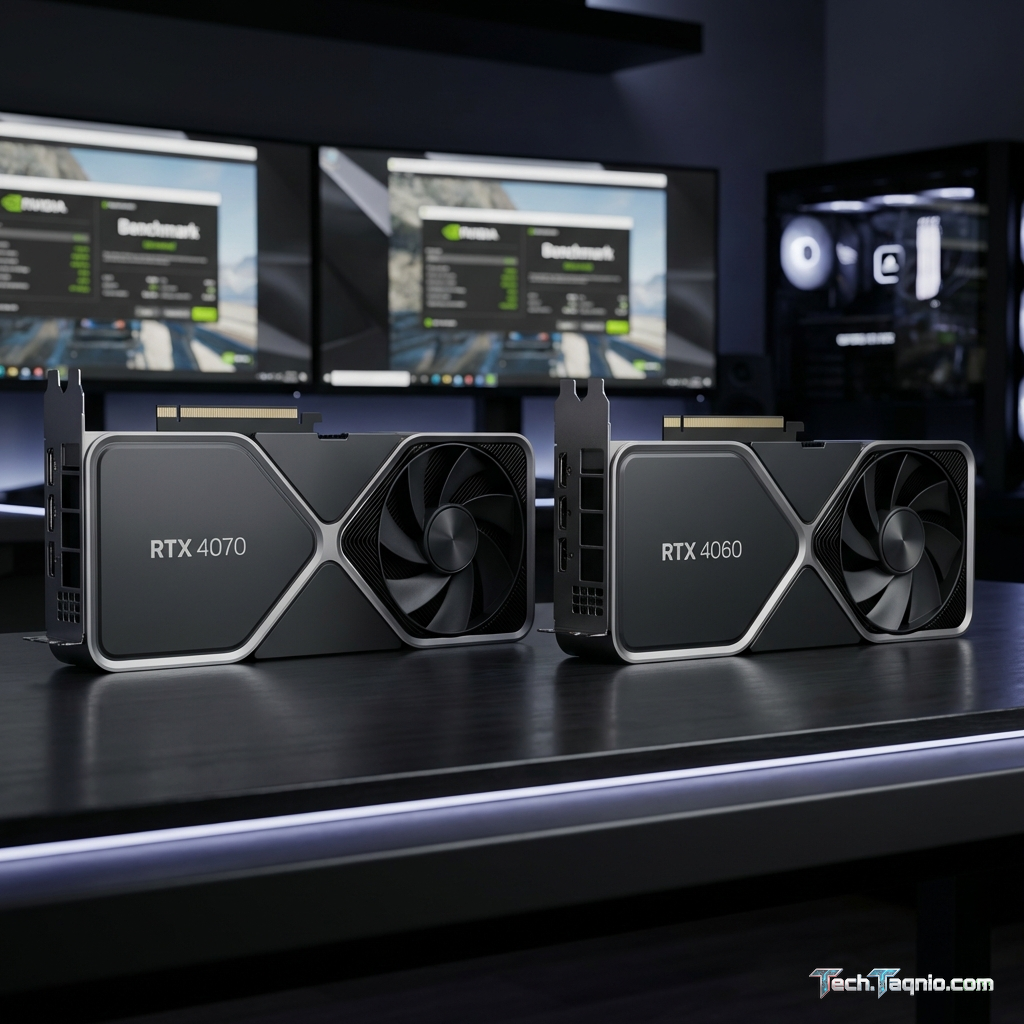
Choosing between the NVIDIA GeForce RTX 4070 and RTX 4060 represents one of the most common dilemmas facing PC gamers
in 2026. Both graphics cards occupy the critical mid-range segment where value meets performance, serving the vast
majority of gamers who want excellent gaming experiences without flagship pricing. Understanding the real-world
differences between these GPUs helps justify the price premium of the 4070 or confirms the 4060 as sufficient for
your needs.
The performance gap between these siblings isn’t as dramatic as their product numbers might suggest, yet meaningful
differences exist in specific scenarios. Resolution targets, game preferences, and longevity expectations all
influence which card delivers optimal value for individual situations. The price difference typically runs
$150-$200, making the decision economically significant.
This comprehensive comparison examines every aspect relevant to your purchasing decision: raw specifications, gaming
benchmarks across various resolutions and titles, ray tracing and DLSS performance, power consumption, thermal
characteristics, and long-term value propositions. By the end, you’ll know exactly which GPU best matches your
gaming requirements and budget.
I. Technical Specifications Compared
Before examining real-world performance, understanding the underlying specifications reveals why performance
differences exist and where each card excels.
GPU Architecture and Core Counts
Both the RTX 4070 and RTX 4060 utilize NVIDIA’s Ada Lovelace architecture, benefiting from significant efficiency and
performance improvements over the previous Ampere generation. However, they implement this architecture at different
scales.
The RTX 4070 features the AD104 die with 5888 CUDA cores, while the RTX 4060 uses the smaller AD107 die with 3072
CUDA cores. This substantial difference in shader hardware directly impacts raw computational throughput,
particularly in scenarios that efficiently utilize available parallel processing resources.
Ray tracing cores follow similar proportions: the 4070 includes 46 RT cores versus 24 in the 4060. Tensor cores for
DLSS acceleration number 184 in the 4070 and 96 in the 4060. These hardware differences affect AI upscaling quality
and ray tracing performance, though both cards support identical feature sets.
Memory Configuration
Memory represents a critical differentiator between these GPUs. The RTX 4070 features 12GB of GDDR6X memory on a
192-bit bus, delivering 504 GB/s bandwidth. The RTX 4060 includes 8GB of standard GDDR6 memory on a 128-bit bus,
providing 272 GB/s bandwidth.
The 4070’s memory advantages become increasingly apparent at higher resolutions and with modern games using detailed
textures. At 1440p with high-quality texture mods or in VRAM-hungry titles, the 4060’s 8GB can become limiting. The
bandwidth difference affects sustained performance when memory pressure increases.
For 1080p gaming with standard texture settings, the 4060’s memory configuration proves adequate. Problems emerge
primarily at 1440p or with games aggressively utilizing available VRAM. Future game requirements may accelerate the
4060’s VRAM limitations.
Power and Efficiency
The RTX 4070 specifies a 200W TDP, while the RTX 4060 draws just 115W. This substantial difference is reflected in
system requirements: the 4070 recommends a 650W power supply versus 550W for the 4060. Partner cards may vary these
requirements based on factory overclocks and cooling implementations.
Performance-per-watt favors the 4060 slightly, making it more suitable for compact builds or systems with power
budget constraints. The 4070’s additional power consumption translates directly into additional heat that cooling
solutions must dissipate.
| Specification | RTX 4070 | RTX 4060 |
|---|---|---|
| CUDA Cores | 5888 | 3072 |
| Boost Clock | 2475 MHz | 2460 MHz |
| Memory | 12GB GDDR6X | 8GB GDDR6 |
| Memory Bus | 192-bit | 128-bit |
| Bandwidth | 504 GB/s | 272 GB/s |
| TDP | 200W | 115W |
| MSRP | $549 | $299 |
II. Gaming Performance Benchmarks
Specifications tell part of the story, but actual gaming performance determines real-world value. Our benchmarks span
multiple resolutions and game categories to reveal performance characteristics across typical usage scenarios.
1080p Gaming Performance
At 1920×1080 resolution, both graphics cards deliver excellent performance, often exceeding common monitor refresh
rates. The RTX 4070 averages approximately 25-35% higher frame rates than the 4060 at this resolution, though both
cards easily surpass 60 FPS in demanding titles and exceed 144 FPS in competitive games.
In demanding AAA titles at 1080p Ultra settings, the RTX 4070 typically achieves 100-130 FPS while the RTX 4060
delivers 75-100 FPS. For 144Hz gaming, the 4070 locks to refresh rates more consistently, while the 4060
occasionally dips below, particularly in CPU-limited scenarios or with ray tracing enabled.
Competitive esports titles show less differentiation. Both cards exceed 200 FPS easily at 1080p, making the
performance difference less meaningful for high-refresh gaming focused on reaction-time-dependent titles. At this
tier, CPU performance often becomes the limiting factor before either GPU reaches capacity.
1440p Gaming Performance
The 1440p resolution reveals clearer differentiation between the GPUs. The RTX 4070 emerges as the clear 1440p
champion, while the 4060 requires DLSS assistance to maintain high frame rates consistently.
At 2560×1440 with high/ultra settings, the RTX 4070 typically delivers 75-95 FPS in demanding modern titles,
providing smooth gameplay that benefits from 1440p visual clarity. The RTX 4060 manages 55-75 FPS in comparable
scenarios, requiring either DLSS utilization or settings reductions for consistent 60+ FPS targeting.
Memory bandwidth and capacity differences become more apparent at 1440p. The 4060’s 8GB VRAM occasionally creates
stuttering in texture-heavy games at this resolution, while the 4070’s 12GB buffer handles these demands without
issue. This gap will likely widen as game VRAM requirements continue increasing.
4K Gaming Capability
Neither card targets 4K gaming as a primary use case, but both can deliver playable experiences with appropriate
expectations. The RTX 4070 achieves 45-60 FPS in many titles at 4K medium-high settings, making it viable for
single-player experiences where consistent 60 FPS isn’t essential.
The RTX 4060 struggles at native 4K, typically delivering 30-45 FPS in demanding games. DLSS becomes nearly mandatory
at this resolution, upscaling from lower render resolutions to achieve playable frame rates. For 4K-focused gaming,
considering higher-tier GPUs would be advisable.
Both cards benefit tremendously from DLSS at 4K, with Quality mode providing frame rates 40-60% higher than native
rendering while maintaining excellent visual quality. DLSS 3 Frame Generation on compatible titles pushes frame
rates higher still, making 4K viable with some caveats.
III. Ray Tracing and DLSS Performance
Modern NVIDIA GPUs feature dedicated hardware for ray tracing and AI-accelerated upscaling. These capabilities
increasingly define gaming experiences in supported titles.
Ray Tracing Performance
Ray tracing performance shows significant differentiation between the 4070 and 4060. The 4070’s additional RT cores
handle ray-traced lighting, reflections, and global illumination with notably higher frame rates.
In heavily ray-traced titles at 1080p, enabling full ray tracing typically costs 40-50% of frame rates for both
cards. The 4070 maintains 50-70 FPS in such scenarios while the 4060 drops to 35-50 FPS, making sustained
high-quality ray tracing more practical on the higher-tier card.
At 1440p with ray tracing, the 4060 essentially requires DLSS to maintain playable frame rates, while the 4070 can
manage some ray-traced effects at native resolution in less demanding implementations. Complex full path-tracing
scenarios push both cards toward DLSS dependence.
DLSS 3 and Frame Generation
Both cards fully support DLSS 3, including the transformative Frame Generation feature that interpolates additional
frames using AI prediction. This technology dramatically increases perceived frame rates with minimal visual impact
when implemented well.
DLSS Quality mode provides native-quality visuals at approximately 67% of the rendering workload. Both cards achieve
substantial frame rate improvements with minimal visual degradation at this setting. Performance and Ultra
Performance modes trade increasing visual artifacts for additional speed.
Frame Generation multiplies displayed frames beyond rendered frames, potentially doubling perceived smoothness. This
feature benefits both GPUs equally in percentage terms but provides larger absolute frame rate gains on the faster
4070. Input latency implications vary by implementation and sensitivity.
Real-World RT + DLSS Scenarios
The most demanding visual experiences combine full ray tracing with DLSS for playability. In such scenarios at 1440p,
the RTX 4070 achieves 60-90 FPS with Quality DLSS and path tracing in supported titles. The RTX 4060 manages 45-70
FPS in comparable scenarios, still playable but with less headroom.
For gamers prioritizing ray-traced experiences, the 4070 provides meaningfully better capability. The 4060 handles
ray tracing acceptably but requires more aggressive DLSS settings or resolution compromises to maintain smooth
gameplay.
IV. Thermal Performance and Noise
Graphics card thermals and acoustics affect daily gaming comfort. Cooling solution effectiveness varies across
partner implementations, but general patterns emerge from TDP differences.
RTX 4070 Thermal Characteristics
The RTX 4070’s 200W power draw requires robust cooling solutions. Quality partner cards maintain GPU temperatures in
the 65-75°C range under gaming load with acceptable acoustics. Budget implementations may run warmer or louder to
compensate for less effective heatsinks.
Triple-fan designs from ASUS, MSI, and Gigabyte typically achieve the best thermal-acoustic balance. Dual-fan compact
variants suit smaller cases but may run slightly louder under sustained load. Case airflow significantly influences
observed temperatures.
RTX 4060 Thermal Characteristics
The RTX 4060’s modest 115W TDP enables excellent thermal characteristics with compact coolers. Dual-fan and even
single-fan implementations maintain comfortable temperatures and noise levels. This card suits compact builds and
systems with restricted airflow far better than higher-power alternatives.
Many RTX 4060 variants achieve near-silent operation during gaming, with fan curves that keep noise minimal while
maintaining temperatures below 70°C. This thermal efficiency represents a genuine advantage for noise-sensitive
users or compact system builders.
V. Value Analysis and Price Considerations
Price-to-performance ratios ultimately determine graphics card value. Understanding what each dollar buys helps make
economically rational decisions.
Current Market Pricing
NVIDIA’s MSRP positions the RTX 4070 at $549 and the RTX 4060 at $299. Street pricing typically matches or undercuts
these targets, with partner cards ranging from MSRP to $50 above for premium cooling solutions.
The $250 price difference represents roughly 83% more investment for the 4070. Performance improvements of 25-40%
depending on scenario mean the 4070 delivers approximately half the performance improvement of its price increase,
measured in raw frames per dollar.
Performance Per Dollar
At MSRP, the RTX 4060 offers superior performance per dollar for buyers prioritizing value. The 4070 becomes
economically justified when its absolute performance level is required, such as targeting consistent 1440p 144Hz
gaming or preferring higher sustained frame rates.
The calculation shifts at non-MSRP pricing. Sales that reduce the 4070’s price toward $450-$500 substantially improve
its value proposition, while the 4060 at sub-$280 pricing represents exceptional value for 1080p-focused gaming.
Longevity Considerations
Future-proofing favors the RTX 4070’s larger memory buffer and higher overall performance. As games increase VRAM
requirements, the 4060’s 8GB may become limiting sooner than the 4070’s 12GB. This difference extends the 4070’s
competitive gaming lifespan.
For gamers planning 4-5 year GPU lifespans, the 4070’s additional capability provides longer relevance at high
settings. Those upgrading more frequently or tolerating gradual settings reductions may find the 4060’s lower
initial investment preferable.
VI. Which GPU Should You Choose?
Different gaming scenarios and priorities lead to different optimal choices. These recommendations match common user
profiles to appropriate GPU selections.
Choose RTX 4070 If:
You game at 1440p primarily: The 4070 delivers the consistent high frame rates 1440p gaming demands.
Its memory bandwidth and capacity handle this resolution without compromises, maintaining smooth performance that
justifies higher-resolution monitors.
Ray tracing matters to you: Enhanced RT performance enables ray-traced gaming without severe frame
rate penalties. If visual fidelity improvements from ray tracing enhance your gaming enjoyment, the 4070 provides
meaningfully better experiences.
You keep GPUs for 4+ years: Greater performance headroom and larger VRAM buffer extend competitive
relevance. The 4070 will handle new game requirements longer before settings reductions become necessary.
You want high-refresh 1080p: Targeting 165Hz+ at 1080p benefits from the 4070’s ability to maintain
frame rates at these levels in demanding titles where the 4060 might occasionally dip below target.
Choose RTX 4060 If:
1080p 144Hz is your target: The 4060 comfortably achieves this common performance target in most
games. Spending more for additional performance beyond your display’s capability provides diminishing returns.
Budget optimization is important: The $250 saved versus a 4070 upgrades peripherals, monitors, or
other components. For complete system builds on limited budgets, the 4060 enables higher spending elsewhere.
Power efficiency matters: The 85W TDP difference translates to lower electricity costs, less heat
output, and quieter operation. Compact builds, hot climates, or noise-sensitive environments favor the 4060’s
efficiency.
You upgrade frequently: Shorter upgrade cycles reduce longevity importance. Buying the 4060 now and
upgrading to next-generation mid-range in 2-3 years may provide better cumulative performance than extending 4070
ownership.
VII. Common Purchasing Mistakes to Avoid
Both GPUs serve their markets well, but mismatched expectations lead to dissatisfaction. Avoid these common errors
when purchasing.
Buying RTX 4070 for Lower Resolution
Gaming at 1080p 60Hz doesn’t require RTX 4070 performance. The additional capability remains unused while the price
premium provides no practical benefit. Match GPU power to display capability for optimal value.
Buying RTX 4060 for Higher Resolution
Planning 1440p 144Hz gaming on an RTX 4060 leads to either compromised frame rates or excessive DLSS dependence. If
1440p high-refresh represents your target, budget for the GPU that actually achieves it consistently.
Ignoring Future Monitor Upgrades
Current monitor capability shouldn’t be the only consideration. If you’re likely to upgrade to 1440p within the GPU’s
lifespan, buying accordingly prevents premature GPU upgrade requirements.
Overvaluing Ray Tracing
Unless ray tracing visually impacts titles you actually play, don’t overspend chasing RT performance. Most games
either don’t support ray tracing or implement it subtly enough that the performance cost exceeds visual benefit.
VIII. Partner Card Recommendations
Both GPUs come from multiple partners with varying cooling solutions, factory overclocks, and price points. These
recommendations identify excellent implementations at various price tiers.
RTX 4070 Partner Cards
Best Overall: ASUS TUF Gaming RTX 4070 OC offers excellent cooling, reasonable factory overclock,
and durable construction at competitive pricing, typically $549-$579. The triple-fan design maintains low
temperatures with minimal noise.
Best Premium: MSI Gaming X Trio RTX 4070 provides maximum cooling performance and lowest noise
levels at $599-$629. Slightly higher investment delivers measurable thermal and acoustic improvements for
enthusiasts.
Best Value: Gigabyte Windforce OC RTX 4070 offers competent cooling and reasonable performance at
MSRP or below during sales. Adequate for most builds without premium pricing.
RTX 4060 Partner Cards
Best Overall: ASUS Dual RTX 4060 OC combines compact dual-fan design with effective cooling at
$299-$319. Fits smaller cases while maintaining excellent thermal characteristics.
Best Premium: MSI Gaming X RTX 4060 offers silent operation and superior aesthetics at $329-$349.
The premium provides meaningful noise reduction for silence-focused builds.
Best Budget: Gigabyte Eagle RTX 4060 reliably matches MSRP at $299, offering standard performance
without premium features. Ideal for buyers prioritizing core performance over cooling excellence.
IX. Conclusion
The RTX 4070 vs RTX 4060 decision ultimately depends on resolution targets, budget constraints, and performance
expectations. The 4070 justifies its premium for 1440p-focused gamers seeking consistent high-refresh performance
and those prioritizing ray tracing capability or long-term relevance. The 4060 delivers exceptional value for 1080p
gaming, efficient operation, and budget-conscious builds without meaningful performance sacrifices at targeted
resolutions.
Neither card represents a poor choice within appropriate contexts. The 4060’s remarkable efficiency and competitive
1080p performance make it the mid-range volume leader, while the 4070’s balanced capability serves the large market
of 1440p enthusiasts. Consider your actual gaming scenarios rather than theoretical maximums when deciding.
For most gamers targeting 1080p 144Hz, the RTX 4060 provides everything needed at a compelling price. Those with
1440p aspirations, ray tracing priorities, or longer upgrade horizons find the RTX 4070’s additional investment
worthwhile. Match actual requirements to appropriate hardware for satisfying long-term gaming experiences.
For related GPU content, explore our guides on the best budget GPUs for 1080p gaming
and how to build a
gaming PC featuring these cards.