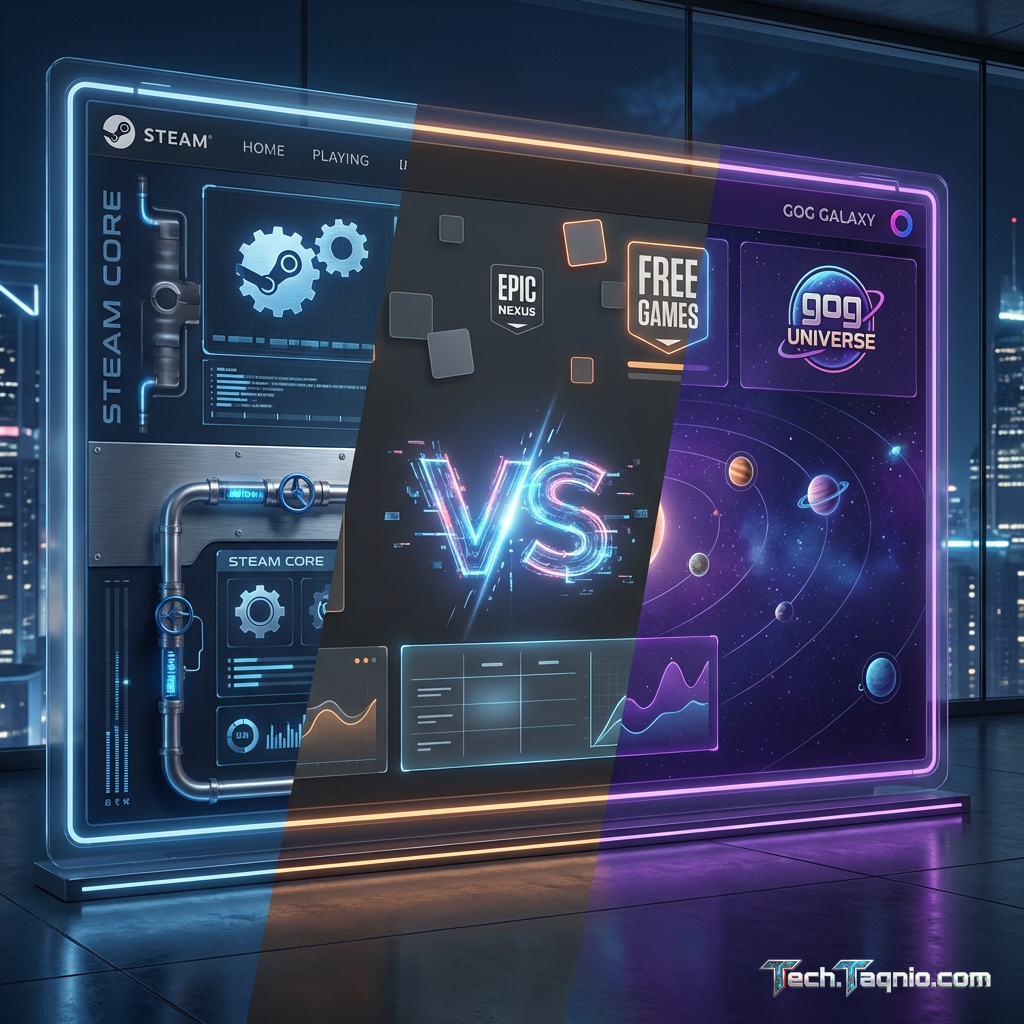
PC gaming requires navigating multiple game launchers, each competing for your purchases and attention. Steam
dominates market share, Epic Games offers aggressive exclusives and free games, and GOG champions DRM-free
ownership. Understanding each platform’s strengths helps allocate gaming budgets effectively and avoid unnecessary
fragmentation.
Beyond simple game purchasing, launchers provide community features, achievement systems, cloud saves, workshop
support, and friend management. The platform where you buy games affects long-term gaming experience beyond initial
purchase price. Choosing wisely now prevents future regret.
This comprehensive guide compares major game launchers to help you make informed purchasing decisions in 2026.
I. Steam
Valve’s Steam remains the dominant PC gaming platform, with the largest game library and most mature feature set.
Key Strengths
Unmatched Library: Over 70,000 games available, from AAA releases to indie experiments. If a PC game
exists, it’s almost certainly on Steam. Third-party keys from authorized retailers expand purchasing options.
Steam Workshop: Integrated mod support for thousands of games. Browse, subscribe, and automatically
install mods without leaving the client. Community-created content extends game longevity dramatically.
Social Features: Comprehensive friend system, game gifting, activity feeds, and Steam Chat. Groups,
events, and community hubs foster gaming communities around titles.
Remote Play: Stream games to other devices within your network or across the internet. Remote Play
Together shares local multiplayer games with distant friends.
Steam Deck Integration: Games purchased on Steam work seamlessly on Valve’s portable hardware.
Proton compatibility layer enables Windows games on Linux-based Deck.
Achievement System: Robust achievement tracking with rarity statistics, showcase options, and
completion percentages.
Sales Events: Legendary seasonal sales offer substantial discounts, though publishers increasingly
control pricing depth.
Weaknesses
30% Revenue Share: Steam takes the largest cut from developers, theoretically affecting game pricing
or developer sustainability.
Interface Bloat: Years of feature additions created cluttered UI, though recent overhauls improve
navigation.
Quality Control: Easy publishing access floods the store with low-quality titles, requiring curation
vigilance.
Best For
Most PC gamers should consider Steam their primary platform. The feature depth, library size, and ecosystem maturity
outweigh competitor advantages for typical users.
II. Epic Games Store
Epic’s aggressive market entry brought competition, exclusives, and free game offerings.
Key Strengths
Free Games: Weekly free game offerings have distributed hundreds of titles worth thousands of
dollars. Checking Epic weekly builds substantial library at zero cost.
Developer-Friendly Revenue: 12% Epic share versus Steam’s 30% motivates developer/publisher
preference, occasionally resulting in lower prices or exclusive arrangements.
Exclusive Partnerships: Timed exclusives provide access to significant releases unavailable
elsewhere initially. Exclusivity periods typically last 6-12 months.
Creator Codes: Support content creators through optional purchase codes sharing revenue with
creators.
Fortnite Integration: Seamless access to Epic’s massively popular flagship title.
Weaknesses
Limited Features: No achievement system, basic friend features, limited community tools. Years
behind Steam in functionality.
No Workshop: No integrated mod support—modding requires manual installation or third-party tools.
Cart System Issues: Historically problematic shopping cart finally improved, but trust issues
persist.
Library Organization: Limited categorization, filtering, and organization options for growing
libraries.
Best For
Claim weekly free games regardless of other platform preferences. Purchase Epic exclusives during exclusivity periods
when desired immediately. Consider Epic for purchases where price advantages exist.
III. GOG Galaxy
CD Projekt’s GOG emphasizes ownership, DRM-free games, and customer-friendly policies.
Key Strengths
DRM-Free: Every GOG game installs without copy protection, playable offline forever without account
verification. True ownership rather than license access.
Installer Downloads: Download standalone installers for archival, sharing across personal devices,
or offline storage. No launcher required for gameplay.
Classic Game Preservation: Extensive library of older titles with compatibility patches enabling
play on modern systems.
Galaxy Multi-Launcher: GOG Galaxy 2.0 integrates Steam, Epic, PlayStation, Xbox, and other platforms
into unified library view. See all games across platforms in single interface.
Refund Policy: 30-day money-back guarantee covers any reason, even after playing extensively—the
most generous major platform policy.
Weaknesses
Smaller Library: Fewer games than Steam, particularly AAA releases choosing DRM protection over GOG
distribution.
Multiplayer Complications: Some games require online activation or specific launcher versions for
multiplayer, partially negating DRM-free benefits.
Fewer Sales: Smaller platform with less publisher negotiating power means fewer deep discounts than
Steam.
Best For
Gamers prioritizing ownership over convenience, classic game enthusiasts, those concerned about platform dependency,
and anyone valuing consumer-friendly policies.
IV. Other Notable Launchers
EA App (Origin Replacement)
Required for EA titles. Includes EA Play subscription integration. Limited to EA games but necessary for titles like
FIFA, Madden, Battlefield, and The Sims.
Ubisoft Connect
Required for Ubisoft games even when purchased on Steam. Integrates with Ubisoft+ subscription. Achievements and
rewards system provides in-game bonuses.
Xbox App
Microsoft’s PC gaming hub. Required for Game Pass PC access. Cloud gaming integration enables streaming without
downloads. Purchases link to Microsoft account across PC and Xbox.
Battle.net
Blizzard’s exclusive launcher for World of Warcraft, Overwatch, Diablo, and Call of Duty. No alternative purchasing
options—Blizzard games require Battle.net.
Amazon Games
Delivers Amazon Prime Gaming free titles. Limited exclusive releases (Lost Ark, New World). Minimal feature set
beyond game delivery.
V. Comparison Overview
VI. Strategic Recommendations
Primary Platform: Steam for most gamers. Feature depth, community, Workshop, and library
compatibility justify centralization.
Secondary Claiming: Epic free games weekly—claim even titles you might never play. Zero cost builds
valuable library.
Ownership Priority: GOG for DRM-free preferences, classic games, and archival concerns.
Publisher-Specific: EA App, Ubisoft Connect, Battle.net as required—avoid purchasing duplicates
across platforms.
VII. Conclusion
No single launcher perfectly serves all needs. Steam’s comprehensive features make it the default choice for most
purchases. Epic’s free games deserve weekly attention regardless of purchasing preferences. GOG rewards those
valuing ownership and consumer-friendly policies.
Multiple launcher installation creates minor inconvenience but maximizes options. Focus primary purchasing on
preferred platform while claiming free content everywhere. The competitive launcher landscape benefits consumers
through improved features and aggressive promotions.
For related content, explore our Windows gaming optimization
and game recording software
comparison.